
Active Warrants in Hawaiʻi
An active or outstanding warrant in Hawaiʻi is one the court has not closed. No one has recorded it as served, recalled, or resolved. The issuing Hawaiʻi court keeps the case file behind the order. Service falls to the state's Department of Law Enforcement Sheriff Division, which serves warrants and court process across all the islands, while county police departments handle local policing under their own commands. Hawaiʻi splits the work this way. Even so, that split builds no public statewide warrant list. The Judiciary runs a tool called eBench Warrants for approved law-enforcement and criminal-justice users only. A member of the public cannot log in and search it. Hawaiʻi eCourt Kōkua does offer public case information. It is not a warrant registry, though. So use any warrant-related case result to find the responsible court, then ask the issuing clerk in Hawaiʻi whether the warrant remains active.
Hawaiʻi Has No Public Warrant List
Hawaiʻi keeps its warrant data behind agency walls. The Hawaiʻi Judiciary and the Department of Law Enforcement describe an agency warrant system, not a public full-state search. There is no such public list. No Hawaiʻi source offers name, county, status, or warrant-number filters to the public. The eBench landing page shows no warrant-search fields or results. A sign-in screen is not proof a Hawaiʻi resident can register. That matters when comparing Hawaiʻi sources. A county warrant notice, a fugitive profile, or an arrest report covers a single event. None inventories Hawaiʻi warrants. No statewide amnesty or warrant roundup exists in Hawaiʻi. A limited local service or a news release is not statewide coverage. For case-level action, start with the issuing Hawaiʻi court. The Hawaiʻi county directory points to local police and courthouse contacts. It is no substitute for a warrant database. Each Hawaiʻi county handles its own records. The Honolulu Police Department's warrant-policy page lays out general agency process. It offers no individual Hawaiʻi warrant search and no statewide active-warrant list.
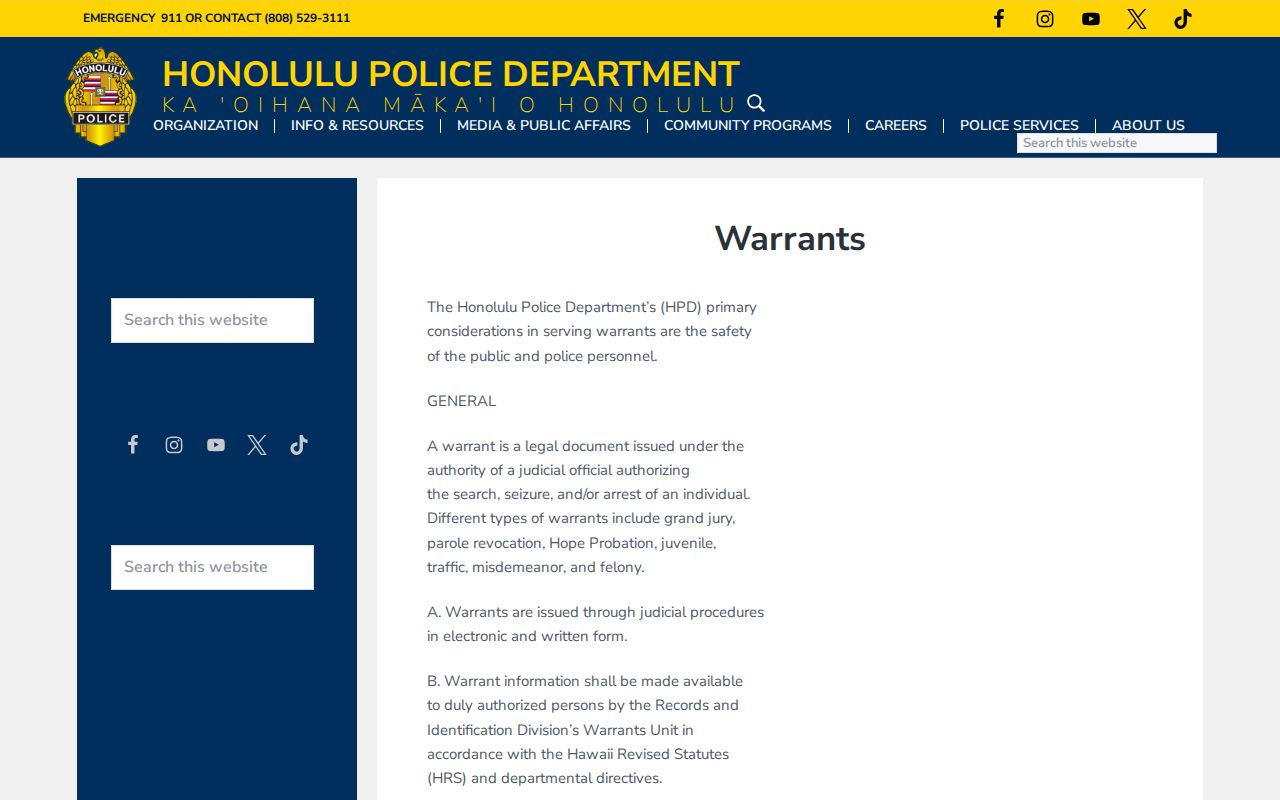
This excerpt from an official Hawaiʻi page supports the process discussion only. It displays no person's warrant status.
How Statewide Active-Warrant Data Works
Hawaiʻi's eBench system serves approved agency users. They can search covered traffic, criminal, and certain non-Family Court civil warrants. The public landing page says Hawaiʻi warrant records are updated multiple times daily. A Judiciary fiscal-year report goes further. It describes electronic warrant delivery and synchronization, including traffic-warrant sync several times daily and within 24 hours. Those statements describe system operations inside Hawaiʻi's courts. They are not a public promise that every new, served, or recalled Hawaiʻi warrant appears instantly. Public coverage in Hawaiʻi is not fully documented. Neither the Hawaiʻi wording nor the report resolves every Family Court category. Neither publishes a court-by-court feed list. So do not assume all Hawaiʻi warrant types, courts, or status updates reach even authorized users. The public sees far less. Exact Hawaiʻi agency permissions and system result limits stay undisclosed on the public page.
Note: Hawaiʻi eBench reports multiple daily updates, but a missing public case entry cannot establish that no Hawaiʻi warrant exists.
eBench and Hawaiʻi Warrant Data
Hawaiʻi runs two separate electronic layers here. eBench Warrants is the Hawaiʻi Judiciary warrant system reserved for approved agency users. eCourt Kōkua is the public side. That Hawaiʻi portal offers case information and documents. A docket event there may connect to a warrant, but there is no public warrant-only filter, and coverage stops short of all Hawaiʻi public courthouse records.
| System | What It Shows | Access |
|---|---|---|
| Hawaiʻi eBench Warrants | Covered Hawaiʻi traffic, criminal, and certain civil warrants | Approved law-enforcement and criminal-justice users |
| Hawaiʻi eCourt Kōkua | Available Hawaiʻi case information, events, and documents | Public access, with exclusions and limits |
| Hawaiʻi issuing court record | Official Hawaiʻi case, order, and court action | Contact the correct court division |
The Hawaiʻi Judiciary spells out the public portal's coverage and its caveats in its eCourt Kōkua FAQs. Read them before relying on a search. The FY25 report describes electronic transfers. It publishes no complete public Hawaiʻi warrant schema. A Hawaiʻi case screen can guide a follow-up; the issuing Hawaiʻi court confirms the record of decision.
What an Active Warrant Shows
The state publishes no statewide Hawaiʻi warrant entry schema. So the fields that follow serve two purposes. They show what a public case search may reveal, and what to ask the clerk to confirm. Neither is a promise that eCourt Kōkua displays a complete warrant record. The Judiciary's case manual lists case, party, docket, offense, and some bail or bond information. Access limits still apply.
| Warrant Number | Format not public Public Hawaiʻi materials do not publish a statewide warrant-number format. |
|---|---|
| Subject Name | Available Hawaiʻi party information may help locate a case. Confirm identity using case details, not name alone. |
| Charge / Offense | Some Hawaiʻi case views include criminal offenses. A visible charge does not state the current warrant status. |
| Issuing Court | Hawaiʻi case details may identify court and location. The issuing division controls the order. |
| Bail Amount | Bail or bond information may appear in Hawaiʻi case details. Ask the clerk whether the amount and terms remain current. |
| Status | Public Hawaiʻi case status and docket events are not universal warrant status codes. |
Hawaiʻi's online case view may carry a last-updated date. That date alone proves nothing. It shows neither service nor recall of a Hawaiʻi warrant unless the docket records a related event. A Hawaiʻi court clerk can tell you whether another order or appearance is still due.
Hawaiʻi Case Codes Are Not Warrant Status
A docket code labels one entry in a Hawaiʻi case history. It is not a statewide active-warrant filter. The Judiciary’s official code glossary names bench-warrant events like order, creation, service, recall, return unserved, and rescheduling. So read each docket line in context. Then ask the clerk what action actually followed it.
- BWO / BWT
- Bench Warrant Ordered or Bench Warrant Created. These are docket events, not current-status guarantees.
- BWS
- Bench Warrant Served, a docket label for a service event.
- BWRC
- Bench Warrant Recalled, a docket label. Confirm the court entered the recall and whether other conditions remain.
- INACTIVE
- A case may be unable to proceed until an event occurs. The court’s code list gives failure to appear or a bench warrant as one example.
- MRBW
- Motion to Recall Bench Warrant. A motion filing is not the same as an order granting relief.
Case status tells a different story. An “active” label just means the case is still moving. Closed or judgment-satisfied marks describe the overall case disposition, not each separate court order. The Hawaiʻi glossary helps you read a docket. It is no substitute for asking the court directly. The Judiciary’s CourtConnect code glossary lists the docket-event meanings above, and the page it leads to shows code-reference material rather than any person-specific Hawaiʻi warrant record.
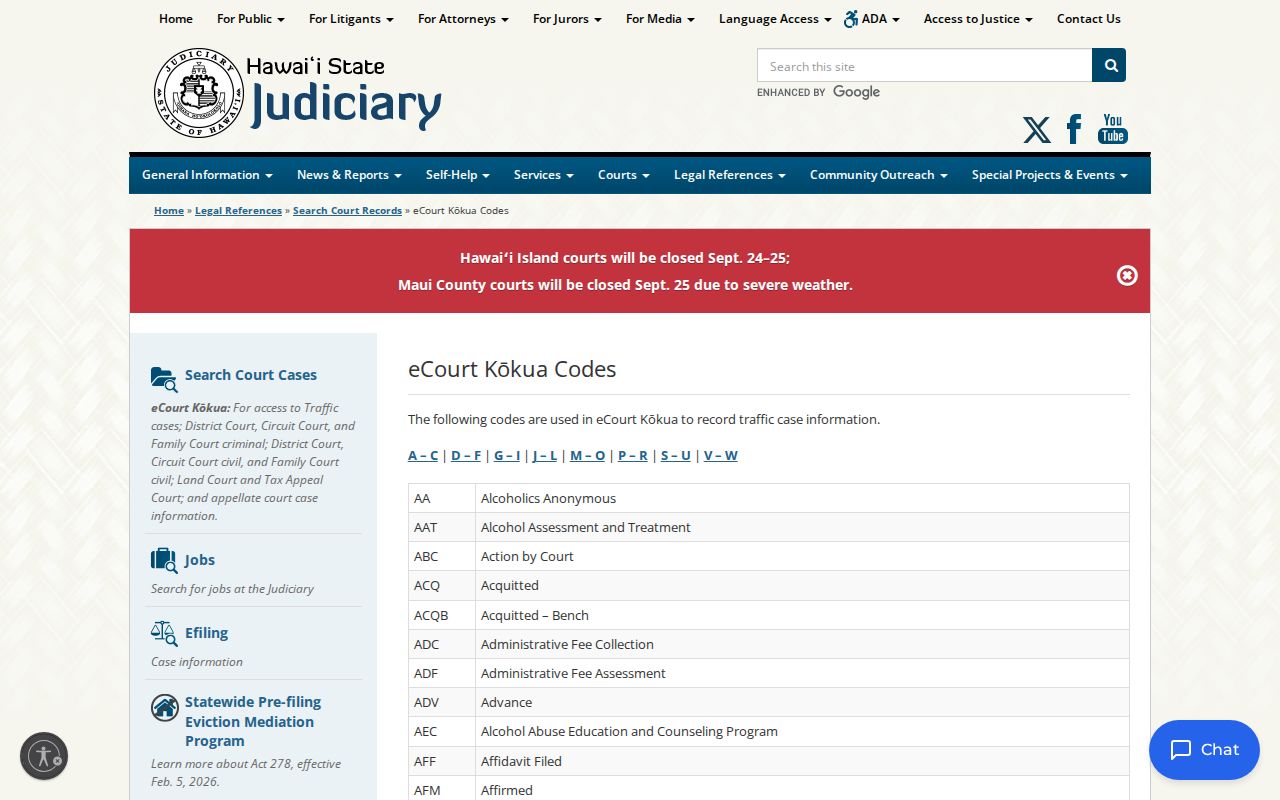
A code explains a case-history entry, nothing more. Only the issuing Hawaiʻi court can confirm whether an active warrant still stands.
Most-Wanted Lists and Warrant Roundups
A fugitive page is not a warrant search. The Hawaiʻi DLE posts no dedicated statewide Most Wanted roster. The U.S. Marshals Service District of Hawaiʻi does link to selected “Profiled Fugitives” notices and describes the Hawaiʻi Fugitive Task Force. That federal program page is limited, though. It is not a full public index of Hawaiʻi warrants. County agencies put out selected news and tip notices, but those fill no statewide gap either.
Key Point: The U.S. Marshals Service District of Hawaiʻi page describes federal fugitive work and selected profiles. It does not publish a full active-warrant register.
Use an official profile page only for the information it publishes. Do not treat a person’s absence from a selected list as proof that no warrant exists, and confirm any personal case with the issuing court.
Curated Hawaiʻi Warrant Profiles
Federal fugitive material answers a different question than your own warrant status. The U.S. Marshals Service page describes the Hawaiʻi Fugitive Task Force, a coordinated group that can draw on federal, state, and local partners. Its public profiles are selected notices. They are not a full count of every county and circuit warrant. Tip channels are just as narrow. The U.S. Marshals Service and county Crime Stoppers programs take information on matters of law-enforcement interest, and the Hawaiʻi Attorney General’s Crime Stoppers directory lists them. None of them checks a caller’s own warrant or grants legal clearance. Never contact a person shown in an official notice or try to investigate a case yourself. For your own Hawaiʻi warrant record, call the issuing court. The county directory handles local agency routing.
Note: A selected fugitive profile can change as a case develops, while an unlisted warrant may remain enforceable.
If Your Name Is on a List
First, make sure a Hawaiʻi notice that seems to match your name really is you. Check the location, case number, and other details. Then reach the court or agency named in the notice through its official channel. On a court warrant, ask the issuing clerk about status, bail, required filings, and whether you need a court date or surrender arrangement. The county directory maps the county-area police and court route, and there are four active court circuits with no separate county sheriff office in each directory area. An attorney can lay out the choices in a specific Hawaiʻi criminal case. The judge and the warrant’s own terms control release and what happens next. Depending on the case, a person may need to appear, arrange surrender, post court-set bail, or file a motion to recall or quash the warrant. Hawaiʻi has no single universal bail amount and no public clearance process. HRS §607-8.5 allows an assessment of up to $50 only in certain covered bench-warrant cases, not a general fee on every active warrant.
Important: Confirm the order with the issuing court and consult counsel before arranging a surrender; a warrant may be served during law-enforcement contact.
Missing Hawaiʻi Warrant Results Prove Nothing
A blank search in eCourt Kōkua clears nothing. The case may be confidential, missing from the online view, indexed under another identifier, or simply not reflected in the public display. Even when a docket does appear, it may not show every courthouse record or the newest action. A profile page or police news item works even worse as a warrant index. For a DLE agency record, you can file a request under the Hawaiʻi Uniform Information Practices Act through the department’s UIPA request route. Exemptions can limit what gets released, though. UIPA cannot replace asking the court for a case record, and a request does not open eBench to the public. Court records answer to the Hawaiʻi Court Records Rules and the issuing court’s own access process. When an online result is blank or unclear, ask the issuing clerk which identifiers and steps will find the record. Keep any written response or filed motion from the court. Confirm that a recall or other order was truly entered, because a Hawaiʻi warrant does not vanish just because some online list changed.