
Bench Warrants in Hawaiʻi
A Hawaiʻi bench warrant is a judge's order in a case already before a court. It usually follows a missed required appearance or a failure to follow a Hawaiʻi court order, though the exact trigger depends on the case and the order itself. In criminal matters, HRPP Rule 9 governs the procedure, including a warrant issued after a defendant fails to appear in response to a summons. Civil matters can produce bench warrants too, under a different rule or order. So each Hawaiʻi case turns on its own paperwork. One thing a bench warrant is not: a new criminal charge. It is court process tied to an existing Hawaiʻi case, and it can direct an arrest and a return to court. Until the issuing Hawaiʻi court recalls it or takes other action, the warrant stays live. A missed payment alone is not a universal arrest trigger either. In Hawaiʻi civil traffic cases, default judgment and a driver-license stopper follow a separate path.
Hawaiʻi Bench Warrants and Rule 9
Hawaiʻi Rules of Penal Procedure Rule 9 sets out when a criminal bench warrant may issue in a Hawaiʻi case and what the order must contain. The judge signs it. It names the defendant, the offense, the issue date, and the issuing court. It commands arrest and return before that court, and states bail and any other conditions when set. Execution and return of the warrant also fall under the rule. These are legal requirements, though, not the fields you would see in a public Hawaiʻi warrant search. Three terms come up when you read a Hawaiʻi docket or court notice. A failure to appear, often shortened to FTA, means missing a hearing that required attendance. A recall is the court withdrawing the warrant. To quash is to set a warrant aside by court order. Hawaiʻi's rules use bench-warrant and default terminology, and the state uses no standard statewide capias or capias pro fine term. A docket label, or a missing online entry, never replaces confirmation from a Hawaiʻi court. Current rules are listed in the Hawaiʻi Judiciary rules index.
- FTA
- Failure to appear at a required court event.
- Recall
- A court action withdrawing a warrant.
- Quash
- A court order setting aside a warrant or process.
How a Bench Warrant Is Issued
Everything begins with a court obligation: a required Hawaiʻi hearing, or an order in an open case. If the person does not show up as directed, the Hawaiʻi court reviews the matter under the rule that applies. HRPP Rule 9(a)(5) permits a warrant when a defendant fails to appear in response to a summons. The judge's signed order then identifies the issuing court and directs that the person be arrested and returned there. After issuance, the Hawaiʻi case record and warrant information move through court and law-enforcement channels. Hawaiʻi Judiciary materials describe electronic transfer and updates. The public eBench Warrants landing page says authorized users can search covered traffic, criminal, and certain civil warrants, with updates multiple times daily. That scope is not a completeness guarantee. Any recall, service, or other status change starts with the Hawaiʻi issuing court, and the online case record may not display every courthouse record or protected detail.
The Hawaiʻi Bench-Warrant Assessment
Hawaiʻi law lets a court assess up to $50 when it issues a bench warrant for failure to appear or comply. The authority sits in HRS §607-8.5. Read "up to" carefully. The statute sets no uniform charge for every Hawaiʻi warrant. Nor does it require anyone to pay the maximum.
Assessment is not bail. A possible Hawaiʻi bench-warrant assessment of up to $50 is separate from bail or bond set for release in a particular case. Ask the issuing court what the order requires and where any payment belongs.
There is no single statewide bail amount for all Hawaiʻi warrants. A judge sets bail under the relevant law and the Hawaiʻi case facts. Before paying or traveling to a Hawaiʻi court, confirm the current amount, conditions, payment method, and appearance instructions with the issuing court. The assessment statute is no substitute for checking the warrant. It does not replace the release terms either.
Bench vs Arrest Warrant
Hawaiʻi courts use two kinds of warrants, and both can end in an arrest. The difference is where each one starts. A bench warrant grows out of a case already open in a Hawaiʻi court. Miss a hearing or skip a required step, and the judge may issue one. An arrest warrant works the other way around. It begins with a probable-cause process tied to an alleged offense, before any case exists. The companion page on Hawaiʻi arrest warrants walks through that route. If you already have an open Hawaiʻi case, the distinction matters. A bench warrant points back to something the Hawaiʻi court asked you to do, not to a new offense. It says come back, nothing more. Reading it right takes more than the label. The current order, the docket, and a word from the clerk tell you whether the Hawaiʻi court expects a return appearance, a motion, or some other step.
| Feature | Bench Warrant | Arrest Warrant |
|---|---|---|
| Trigger | Missed appearance or failure to comply in a pending matter | Probable-cause finding for an alleged offense |
| Issuing process | Judge acts under the rule for the case | Judge reviews the complaint or application |
| Case connection | Existing case and court obligation | Criminal complaint or application |
| Next step | Confirm status and ask the issuing court about recall or appearance | Confirm status and ask counsel and the issuing court about response |
Civil Traffic Defaults and Hawaiʻi Bench Warrants
A missed civil traffic ticket in Hawaiʻi does not normally produce a bench warrant. Ignore a civil citation and the court enters a default judgment, then moves to collection, and then adds a Hawaiʻi driver-license stopper that blocks issuance or renewal. That stopper is a licensing problem, not an arrest warrant. The rules come from HRS §291D-7, along with Judiciary guidance on driver-license stoppers. Traffic-crime cases run on a different track. When a Hawaiʻi court requires an appearance and the person skips it, a Hawaiʻi District Court bench warrant can issue under the state's criminal procedure rules. Paying the civil default, posting its cash appearance bond, or clearing the license stopper will not recall a separate criminal warrant on its own. Read the citation, docket, and court order together to see which path fits.
How to Resolve a Hawaiʻi Bench Warrant
First, pin down the case. Pull out any citation, Hawaiʻi court notice, or paperwork from the file. The division that issued the bench warrant matters, because that court controls what happens next. Once you know the division, call the Hawaiʻi court directly. Ask whether the warrant is still active and what filing or appearance the judge wants. Ask whether bail is set. Ask how a recall gets recorded once the bench warrant is cleared. Those answers shape everything that follows. If the case is criminal, talk to a Hawaiʻi attorney first, or check whether you qualify for defense counsel, before you walk into court with a plan. The public Hawaiʻi case portal can speed up the lookup. It shows docket information for many cases, yet it is not a full warrant check. A case that does not appear may be confidential, unavailable online, or indexed under a different spelling. So treat a blank result as a reason to ask the issuing court, not proof that nothing is pending. The Judiciary's Community Outreach Court program page lays out an Oʻahu referral route with eligibility rules and qualifying matters, and it can cover some traffic issues and license stoppers. Read it as a limited program, though, not a statewide amnesty and not a way to run a Hawaiʻi warrant search.
That Hawaiʻi page covers eligibility and referral only. It cannot confirm that your bench warrant qualifies or has been recalled.
- Locate the Hawaiʻi case and identify the court and division that issued the warrant.
- Ask the Hawaiʻi clerk to confirm current status, required appearance or motion, bail, and payment instructions.
- Discuss counsel and safe next steps before surrendering or going to a Hawaiʻi court.
- Follow the court's order, then keep Hawaiʻi-filed paperwork and confirm the record was updated.
Caution: A Hawaiʻi court visit does not guarantee that arrest will be avoided or release will be immediate. Confirm Hawaiʻi court instructions first and do not treat a missing online result as clearance.
MRBW and Hawaiʻi Bench-Warrant Recall
Scroll through a Hawaiʻi docket and you may spot the code MRBW. In the Hawaiʻi public case code list it stands for Motion to Recall Bench Warrant. It is a docket event label, nothing more. It is not a public warrant-status search field. It is also not a universal Hawaiʻi form that every case uses. Bench-warrant entries carry other labels too: ordered, created, served, recalled, returned unserved, and rescheduled. Those words can help you follow a Hawaiʻi case history over time. Still, the clerk is the one to confirm what the latest entry means for the warrant you care about. The Hawaiʻi Judiciary's eCourt Kōkua codes page displays that event-code reference, including docket descriptions for warrant events and motions. A motion to recall is only a request for court action, and filing one does not mean the warrant was recalled or that a hearing is off the calendar. Let any code you see push you toward the Hawaiʻi issuing court for the signed order and the current status.
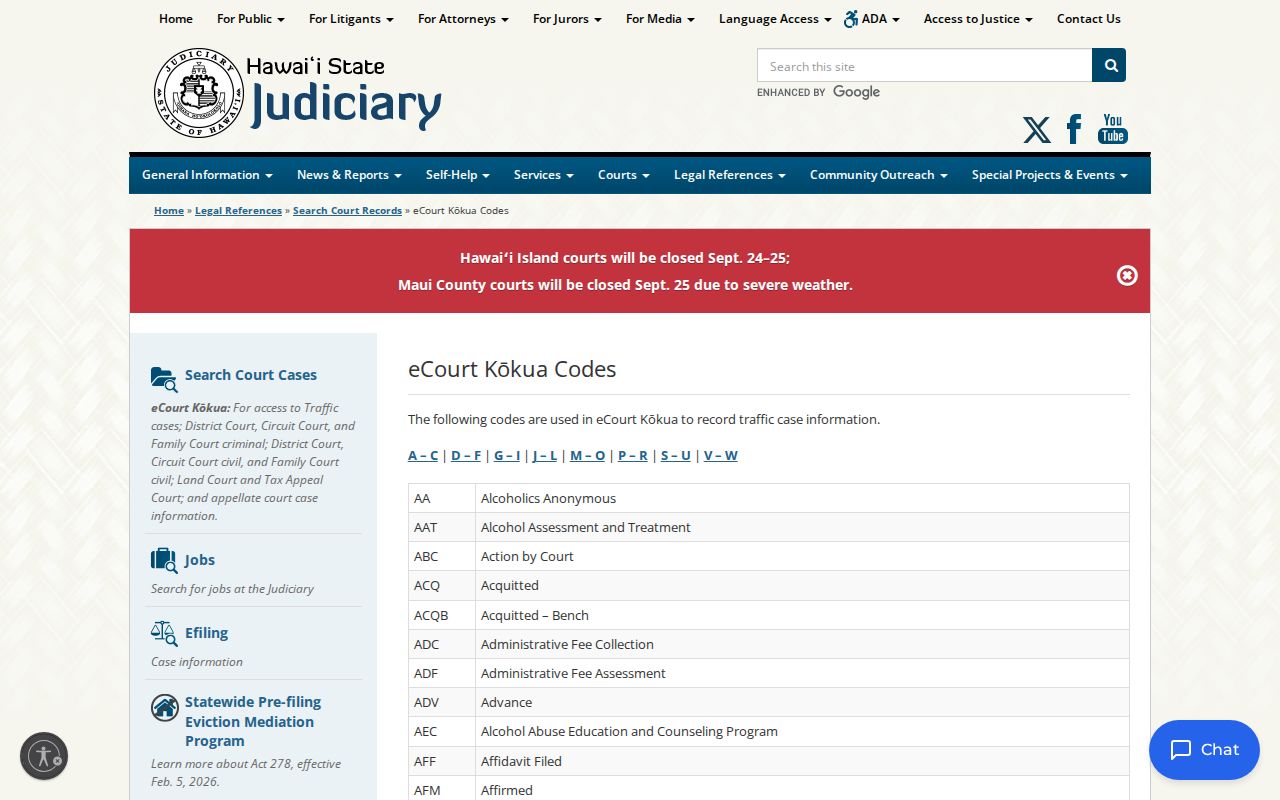
Treat any docket code as a clue. Ask the Hawaiʻi issuing court for the signed order and current status.
Which Court Issued It
Every Hawaiʻi bench warrant belongs to the court that issued it. That court, and its clerk, controls the warrant and any request to recall it. Hawaiʻi runs one statewide Judiciary with four active circuits. District Court takes traffic, ordinance, and misdemeanor matters within its Hawaiʻi jurisdiction. Felony cases go to Circuit Court, the Hawaiʻi general-jurisdiction trial court. Family and juvenile matters sit with the Family Court, a Hawaiʻi Judiciary division that carries extra confidentiality rules under HRS §571-84.
There is no municipal or county magistrate tier here. A city ordinance case in Hawaiʻi generally lands in District Court rather than a city court. To match a case to its circuit and local route, use the Hawaiʻi county directory. The directory holds five county folders because Kalawao is listed on its own, yet the court map shows four active circuits; Kalawao falls under the Hawaiʻi Second Circuit's Maui jurisdiction. No single statewide county clerk keeps every warrant, so once the case is identified, contact the clerk for its court and division. The DLE Sheriff Division and county police both have Hawaiʻi enforcement roles, but they cannot replace the issuing court as the source for recall and case instructions.
Civil Hawaiʻi Forms and Bench Warrants
The blank Hawaiʻi Fifth Circuit District Court form 5DC03 is a civil bench-warrant form. Its fields spell out a civil case: the court and circuit, the Hawaiʻi civil number, the bench-warrant number, the filing party, the order date, the return date and place, the judge's signature, bail, and a service certificate. Reading it can help you recognize what one Hawaiʻi civil form records. It is not, however, a criminal-warrant template, and it sets no standard for what an eBench result contains. That distinction matters when a family member brings an old Hawaiʻi court paper to a clerk. One wrinkle: the form's quiet-hour wording differs between its pages, so the issued order controls. A Hawaiʻi Third Circuit civil form likewise warns against using civil paperwork for criminal or traffic matters. Treat the blank fields as a guide to this one civil purpose, not as proof that every case file carries the same entries. The Hawaiʻi Judiciary hosts the blank Fifth Circuit 5DC03 form for anyone who wants to see it. Use it to spot a Hawaiʻi civil bench warrant on sight, not to predict a separate criminal record.
| Form type | Blank Fifth Circuit civil bench-warrant form |
|---|---|
| Case identifiers | Civil number and bench-warrant number on that form |
| Order details | Order basis, return details, judge signature, and bail fields |
| Service details | Service date, place, and officer certification |